OverviewThe perimeter flame
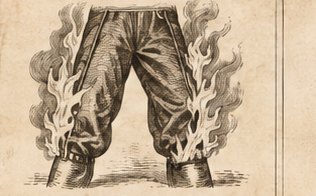
No device in the Archive has been more discussed, or less often worn, than the Flaming-Mouse Pants. They represent the furthest point reached by the art in the direction of force, and the point from which it has spent two and a half centuries retreating.
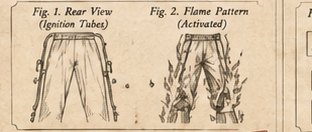
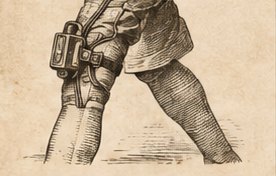
The garment is a pair of buckskin breeches lined at the inseam and cuff with linen-wrapped tubes of tin, charged with spirit of wine and a slow match of the Colonel's own formula. A flint-and-steel striker at each knee, worked by a cord through the waistband, ignites the charge, which burns for between four and nine seconds as a ring of low blue flame around the lower leg. The breeches themselves were proofed with alum. The wearer was not.
The Colonel's specification describes three intended effects, in ascending order: to startle, to repel, and, “where the Mouse persists, or is of a resolute Character,” to incinerate. The record shows the first effect achieved on every occasion, though not always upon the mouse.
The InventorColonel Horatio Goughfton

Horatio Goughfton purchased his first commission at sixteen and was colonel of his own regiment of fusiliers by forty, having fought at Minden, where he was mentioned in despatches, and at Quiberon Bay, where he was not supposed to be. He was by every account brave, stubborn, and humourless, and had been ascended by a mouse at a regimental dinner in Gibraltar in 1769 in front of the Governor's wife.
He spent the next six years and a considerable part of his fortune on the problem. His notebooks, held by the Archive, record trials with nettles, tar, bells, pepper, a small trained ferret, and finally fire, about which he wrote, “It is the one thing every Creature understands.”
The Royal Patent was granted in the spring of 1776. The Colonel sailed for New York with his regiment that summer, and with forty pairs of the breeches, which he proposed to issue to the men for winter quarters. What followed is set out below. He retired to Wiltshire in 1779, declined to discuss the matter, and in his will left his remaining breeches to the Society's predecessor body, a dining club, with instructions that they never be lit. They have not been.
Primary DocumentsOrdnance, insurance and a ballad
Gentlemen,
I have the honour to propose for the use of His Majesty's forces in America a Breeches of my own invention, by which the Soldier in his Quarters is secured against the Mouse, a Creature of which, I am informed, the Colonies have an Abundance.
The Expence is trifling. The Charge is Spirit of Wine, which the Men will not drink if it is in their Breeches. I have tried it upon myself four and twenty times, with the Loss of nothing but a Pair of Stockings and some Hair.
I beg you will not be put off by the Novelty of it.
I am, Gentlemen, your most obedient humble Servant,
H. Goughfton
Resolved, That this Office will not insure any House, Goods or Merchandise in which a Pair of the Breeches called Col. Goughfton's Patent Mouse Breeches is kept, worn, or lit; and that any Policy now in Force upon such Premises shall be void from the Day the said Breeches enter them.
Resolved further, That the Secretary write to Col. Goughfton to inform him of the same, and to ask, with the Committee's Compliments, whether he has considered a Cat.
Sir, I am directed by the Colonel to report the Trial of the Breeches in the Regiment's Quarters during the Month of January. Forty Pairs were issued. They were lit, upon the Approach of Mice, or of what the Men took for Mice, on one hundred and six Occasions.
The Losses are as follows. Tents, three. A Barn, the Property of a Mr. Van Brunt, one, for which the Regiment has paid. The Colonel's Eyebrows. The Eyebrows of the Adjutant. A great Part of the Regimental Colour, which was hung too near the Fire and not, as has been said, set alight by the Colonel deliberately.
Of Mice there were seen to be destroyed none. It is the Opinion of the Officers that the Mice of this Country are not afraid of Fire, having seen a great deal of it lately.
J. Ellery, Adjt.
A New Song, to the Tune of Lillibullero.
The Colonel had a Mouse go up,
Before the Gov'nor's Wife;
He swore no Mouse should climb again
So long as he had Life.
He lin'd his Breeches with the Flame,
He lit them with a Cord —
The Mouse went home, the Tent went up,
And so, they say, did m'Lord.
PatentRoyal Patent, 1776
III
REX
King of Great Britain, France and Ireland, Defender of the Faith, and so forth. To all to whom these Presents shall come, Greeting. Whereas our trusty and well-beloved Horatio Goughfton, Esquire, Colonel in our Army, hath by his Petition humbly represented unto us that he hath, after much Labour and at great Expence, invented “A Breeches or Trowsers for the Protection of the Wearer against the Ascent of Mice, by Means of a Flame of short Duration kindled at the Will of the Wearer about the lower Part of the Leg”:
Know ye therefore that we, of our especial Grace, certain Knowledge and mere Motion, have given and granted unto the said Horatio Goughfton, his Executors, Administrators and Assigns, our especial Licence, full Power, sole Privilege and Authority, that he and they only shall make, use, exercise and vend his said Invention within that Part of our Kingdom of Great Britain called England, our Dominion of Wales, and Town of Berwick upon Tweed, and in our Colonies and Plantations abroad, for the Term of Fourteen Years. Provided always, that the said Breeches be not lit within the Verge of our Court, nor in any of our Dockyards, nor aboard any of our Ships.
In Witness whereof we have caused these our Letters to be made Patent. Witness ourself at Westminster, the Fourteenth Day of March, in the Sixteenth Year of our Reign.
RoyalPatent
Images & IllustrationsPlates


Related InventionsSee also
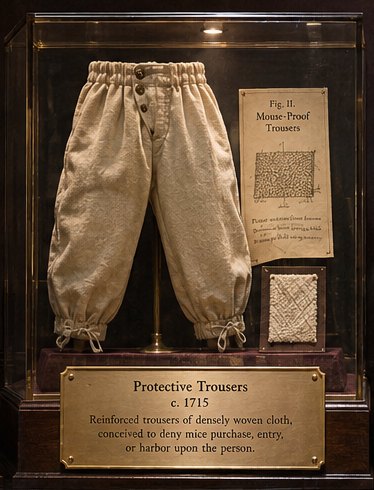
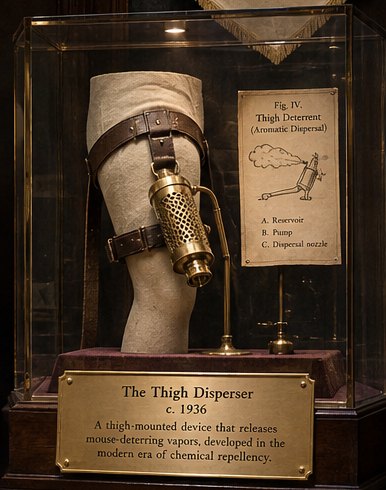
Position of the Society
“The Society does not, and shall not, endorse ignition.”
Resolution of the first Annual Meeting, Bath, 1888, carried without discussion. It is the shortest resolution in the Society's history and the only one never amended.
BibliographySources
- Goughfton, H. (1776). Specification of a Breeches for the Protection of the Wearer against the Ascent of Mice. London: Eyre and Strahan.
- Anon. (1778). The Colonel's Breeches: A New Song. London: sold by the ballad-sellers.
- Fortescue-Mainwaring, C. (1902). “A Forgotten Experiment in the American War.” Journal of the Society for Army Historical Curiosities 3: 77–90.
- Ashby-Lark, W. (1987). Five Centuries of Ingenuity. Bath: P.P.A.M.R.U.L., pp. 41–66.
- Lindqvist, S. (2016). “Startle, Repel, Incinerate: The Escalation Ladder in Eighteenth-Century Deterrence.” Journal of the P.P.A.M.R.U.L. 129: 101–130.