
OverviewFrom dissuasion to response
Where the Squeaky-Slapper warned, the Mouse-Puncher answered. It is the first device in the record to wait for the mouse to commit itself, and the first to reply in kind.
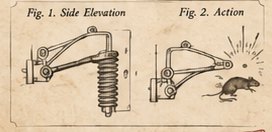
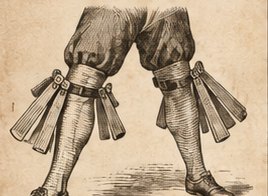
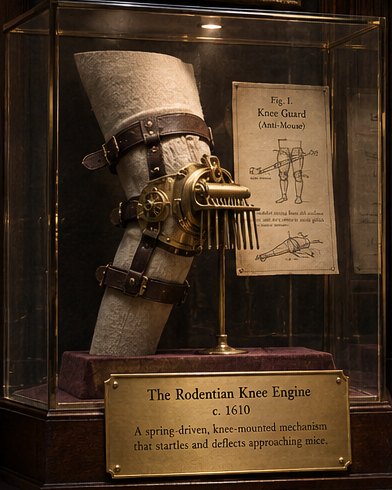
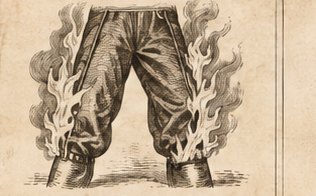
A brass housing, strapped to the outside of the knee, contains a coiled steel spring held under tension by an escapement of the inventor's own design. From the housing descends a fringe of horsehair “feelers” reaching to the top of the boot. A mouse climbing the boot disturbs a feeler; the feeler releases the escapement; the spring drives a jointed arm outward and downward in a short arc, terminating in a small carved boxwood fist, at a mouse which by then is generally somewhere else.
The device was well made, sold steadily to the gentry of the West Country for a decade, and was the subject of the first recorded injury in the history of the art. The injury was not to a mouse.
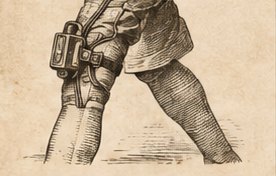
The InventorEzekiel Wreyford, clockmaker of Exeter
Ezekiel Wreyford was apprenticed to a clockmaker in Exeter in 1625 and was making turret clocks for Devon parishes by 1640. His surviving work is sound and unremarkable, with one exception: every clock he built has, inside its case, a small spring trap of a type found in no other maker's work. He seems to have believed that mice were drawn to clocks. He may have been right.
The Civil War took his principal customers, the parish churches, out of the clock market. Wreyford turned to the smaller trade in instruments for gentlemen and in 1652, after an evening at the Ship Inn in which a mouse ascended a magistrate during the reading of a will, he began work on the device that would occupy him for the rest of his life.
He petitioned for letters patent in the spring of 1653, received them that autumn, and moved to London to sell the device under the sign of the Fist and Spring in Cheapside. He returned to Exeter in 1666 when the Fire took the shop. He is buried at St. Petrock's, under a slab that reads, at his request, He was Ready.

Primary DocumentsPetition, deposition, and a pamphlet
To the Right Honourable the Council of State. The humble Petition of Ezekiel Wreyford of the City of Exeter, Clockmaker, sheweth: That your Petitioner hath, by long Study and at great Charge, found out a new Engine to be worn upon the Knee, which by the Force of a Spring doth strike away any Mouse that shall presume to climb the Leg of the Wearer, a Thing never before invented nor used in this Commonwealth.
That the said Mouse is a Creature of no Party, and doth climb the Legs of all Men without Distinction, so that the Engine is of equal Use to every Interest in the Nation.
Your Petitioner therefore humbly prayeth that he may have the sole Making and Selling of the said Engine for the Term of fourteen Years. And he shall ever pray, &c.
Ezek. Wreyford
The Examination of Nathaniel Pym, Ostler at the Half Moon in Exeter, taken upon Oath. Who saith, That upon the Fourth Day of October last he was in the Stable yard and had upon his Knee an Engine of Mr. Wreyford's Making, lent him by his Master for the Keeping of Mice off him in the Hayloft. That a Cat belonging to the House came by and rubbed against the Boot of this Examinant, and the Engine went off.
That the Engine did not strike the Cat, which went away, but struck this Examinant upon the Shin of his other Leg, which he had put forward in Surprise. That he is lame of it yet, and cannot go up a Ladder.
And being asked whether any Mouse was present he saith, Not to his Knowledge.
Nath. Pym, his mark ✕
OR, A Short Discourse upon the Ascending Mouse, and of the New Engine for the Striking of it Away; with Directions for the Winding, Wearing and Care of the same, and a Caution concerning Cats.
By E. W., Clock-maker, the First Inventor thereof.
LONDON, Printed for the Author, and are to be Sold at his Shop at the Sign of the Fist and Spring in Cheapside. 1658.
PatentLetters Patent, 1653
SEAL
1653
To all to whom these Presents shall come, Greeting. Whereas Ezekiel Wreyford of the City of Exeter, Clockmaker, hath by his humble Petition represented that he hath found out a new Engine to be worn upon the Knee for the Striking Away of Mice that shall climb the Leg, and hath prayed our Grant for the sole Use thereof:
Know ye that we, being willing to give Encouragement to all Arts and Inventions which may be for the publick Good, do give and grant unto the said Ezekiel Wreyford, his Executors and Assigns, full Power, sole Privilege and Authority, that he and they only shall make, use, exercise and vend the said Engine within this Commonwealth for the Term of Fourteen Years; Provided that the said Engine be not worn in any Court of Justice, nor in the Presence of this Council, nor discharged in any Publick Thoroughfare to the Danger of Passers-by.
Witness ourselves at Westminster, the Twelfth Day of October, in the Year of our Lord One Thousand Six Hundred Fifty and Three.
Per Breve de Privato Sigillo.
Patent12,684
1. English patents of the period were not numbered. The figure 12,684 was assigned retrospectively by the Society's cataloguers in 1891, from a sequence of their own devising, and has been printed so often that it is now, in the Keeper's phrase, “true by attrition.” The trademark sign appears on the compendium plate and is retained as a matter of record.
Images & IllustrationsPlates


Related InventionsSee also
Position of the Society
“The Society honours Mr. Wreyford's workmanship and his readiness. It notes that a response may be swift without being accurate, and commends to members the caution concerning cats.”
Resolution of the Annual Meeting, Bath, 1891.
BibliographySources
- W[reyford], E. (1658). The Ready Knee, or, A Short Discourse upon the Ascending Mouse. London: printed for the author.
- Calendar of State Papers, Domestic Series, 1653–4, p. 211 (petition and order).
- Tuckett, J. H. (1898). Old Clocks and Clockmakers of Exeter. Exeter: Pollard, pp. 88–93.
- Ashby-Lark, W. (1987). Five Centuries of Ingenuity. Bath: P.P.A.M.R.U.L., pp. 21–38.
- Okonkwo-Reyes, D. (2011). “The Cat Clause: Liability and the Kinetic Deterrent in Commonwealth England.” Journal of the P.P.A.M.R.U.L. 124: 9–27.