Persons Passionately Against Mice Running Up Legs
Preserving the record of a global effort to prevent the ascent of mice upon the human leg.
For as long as there have been legs, there have been mice disposed to run up them, and there have been persons who would rather they did not. The Simulacra Archive holds the papers, patents, apparatus and likenesses of those persons: the clapper-makers, clockmakers, colonels, engineers and quiet householders who, across five centuries and at no small cost to their dignity, their trousers and on one occasion their eyebrows, applied themselves to the problem of the upward-bound mouse.
The Archive is maintained by the Persons Passionately Against Mice Running Up Legs (P.P.A.M.R.U.L.), a learned society incorporated in Bath in 1887. It is open to readers by appointment. It does not lend. It has never, in its history, been visited by a mouse, and it intends to keep it that way.
Five Centuries of Ingenuity in the Defence of Human Legs
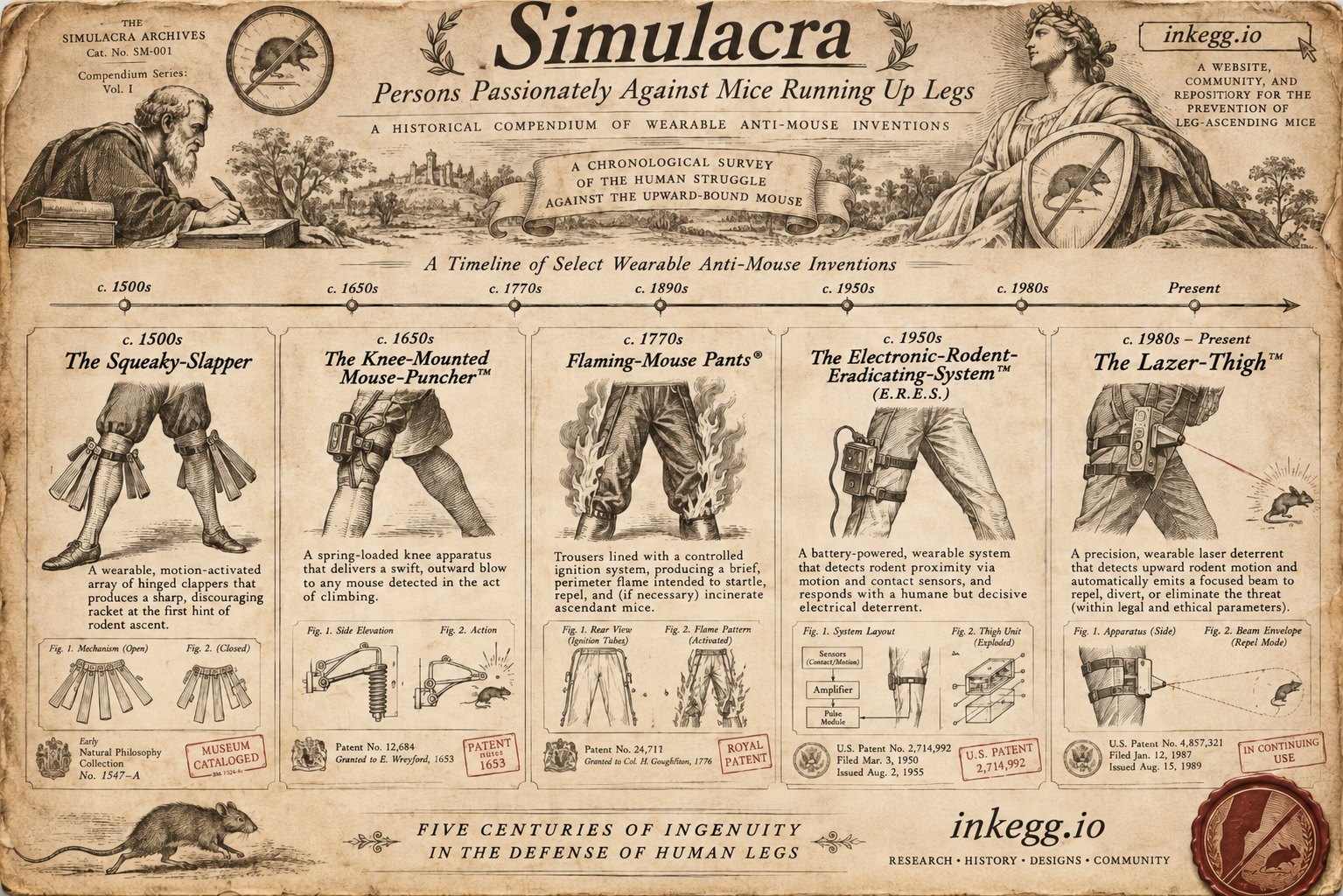
A chronological survey of the human struggle against the upward-bound mouse.
- 1500sMice are first observed, in writing, to ascend the stocking. The Reformation is contemporaneous but unrelated.
-
c. 1538Nuremberg
- 1547
The Nuremberg inventory
A Squeaky-Slapper is entered in the inventory of the city's armoury between a halberd and a bucket. It is the object now catalogued as Early Natural Philosophy Collection No. 1547-A.
- 1600sThe age of springs. Clockmakers turn their attention from the hour to the knee.
- c. 1610
The Rodentian Knee Engine
A spring-driven, knee-mounted mechanism that startles and deflects approaching mice. Maker unknown; the single example is held in the Anti-Mouse Collection.
-
1653Exeter
- 1700sThe century of the protective garment, and of the one garment that protected rather too much.
- c. 1715
Protective Trousers
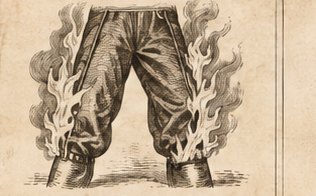
Reinforced trousers of densely woven cloth, conceived to deny mice purchase, entry, or harbour upon the person.
-
1776London & New York
- 1800sAgriculture, industry, and the granary mouse. The problem is taken up by committees.
- 1855
Whitcombe writes to the Royal Agricultural Society
“A contrivance for the prevention of mice ascending the person, a nuisance of no small consequence in granaries, barns, and dwellings.” The Society acknowledges receipt.
- 1887
Founding of the P.P.A.M.R.U.L.
Mrs. Euphemia Thorncastle convenes eleven persons in the Pump Room, Bath, following the incident at the St. Swithin's harvest supper. The Society adopts the motto Non Ascendet.
-
1890Springfield, Mass.
- 1892
The Electro-Repulsor
A wearable electrical apparatus emitting a mild repelling current. Worn on the chest, for reasons its maker did not record.
- 1894
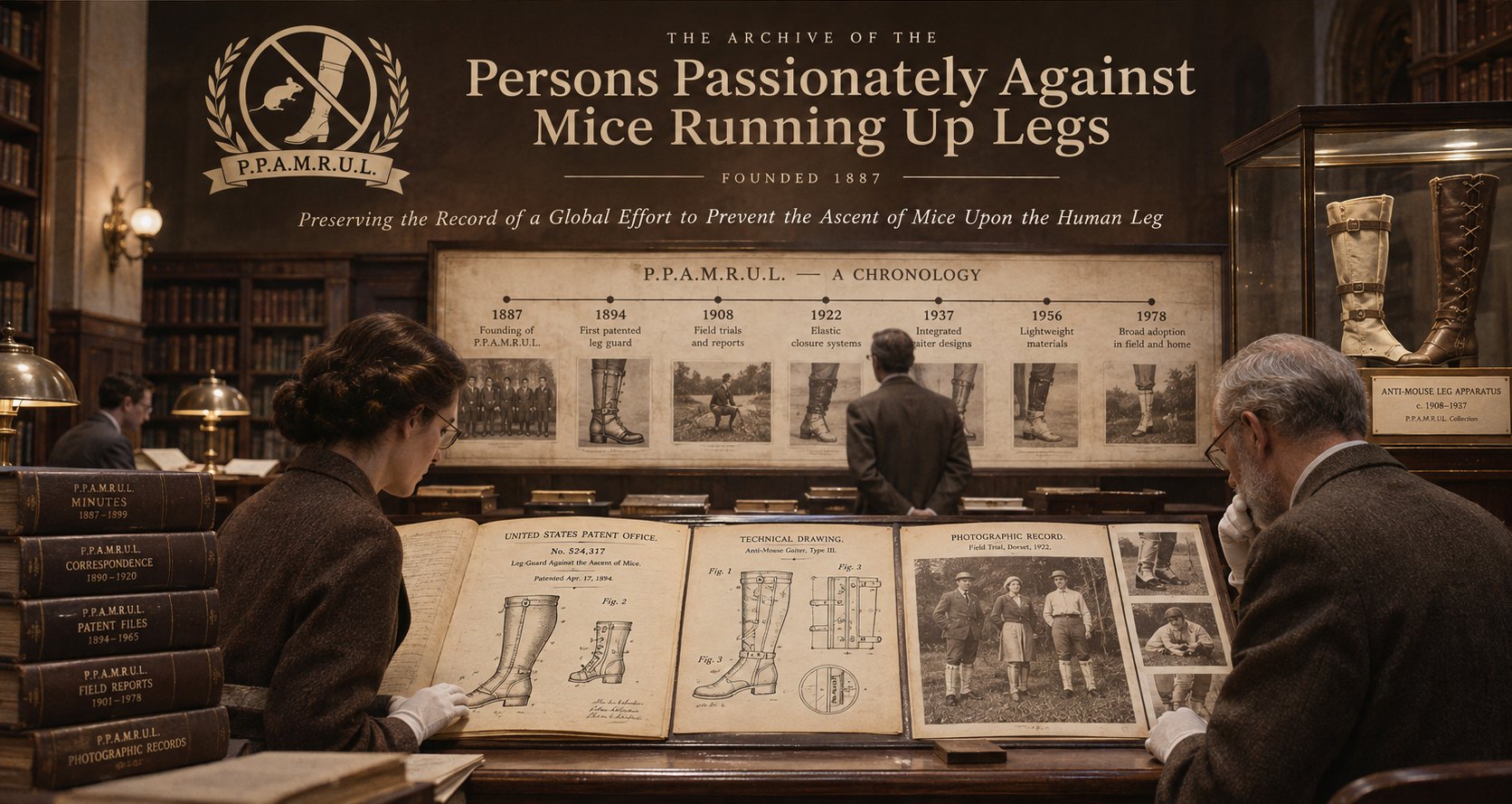
First leg guard patented under the Society's sponsorship
U.S. Patent No. 524,317, Leg-Guard Against the Ascent of Mice, granted 17 April 1894. The Society pays the filing fee and is thanked in the specification.
- 1900sField trials, elastic, electricity, aerosols, and finally the transistor.
- 1908
Field trials and reports
The Society's Field Committee begins its annual trials. Its Field Reports, 1901–1978, run to twenty-two volumes.
- 1922
Elastic closure systems
The Dorset field trial establishes that a snug elastic cuff defeats the mouse more reliably than anything yet devised, including fire. The finding is received with mixed feelings.
- 1936
The Thigh Disperser
A thigh-mounted device releasing mouse-deterring vapours, from the modern era of chemical repellency. Discontinued at the request of the wearer's household.
- 1937
Integrated gaiter designs
The Society publishes its Standard Gaiter, in three sizes and one colour.
-
1950–55Dayton, Ohio
- 1956
Lightweight materials
Aluminium and nylon enter the Society's recommended list. Leather is retained for ceremonial use.
- 1978
Broad adoption in field and home
The Society's ninety-first annual report records, for the first time, that more of its members were protected than were not.
-
1987–Sunnyvale, Calif.
- 2019
The Census of Apparatus
The Society's survey of members finds forty-one Lazer-Thighs in active service, nine E.R.E.S. units in working order, and one Squeaky-Slapper worn on Sundays.
- PresentThe mouse persists. So does the Society.
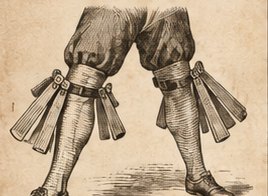
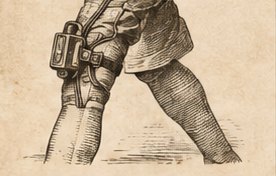
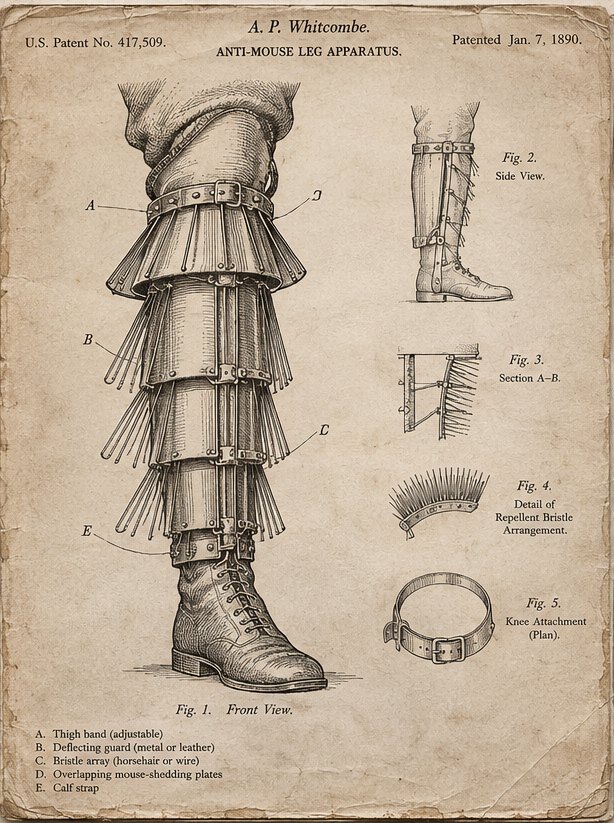
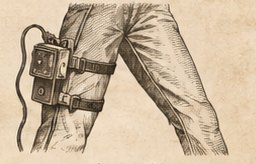
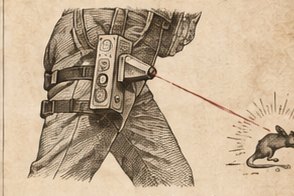
Wearable Anti-Mouse Inventions
Each record gathers the device's documents, filings, patents and likenesses, as held by the Archive.
On the Seriousness of the Matter
It is sometimes suggested, usually by persons whose legs have not been climbed, that the history recorded here is a comic one. The Archive does not take that view. Every object in these rooms was made by someone who had felt, or feared, the small and unmistakable weight of a mouse arriving at the ankle and proceeding north. That they answered it with clappers, springs, fire, bristles, electricity and light is a measure of how seriously they took it.
We ask readers to approach the record in the same spirit. Some of these devices worked. Several did not. One was withdrawn following a fire at a dinner party. None of them was made in jest.
Winifred Ashby-Lark
Keeper of the Archive, Fifteenth of that Office