
OverviewThe passive defence perfected
The Anti-Mouse Leg Apparatus is the culmination of the passive tradition: the conviction, held against the fire and springs of the previous two centuries, that the leg need not fight the mouse if it can simply be made an inhospitable route for one.
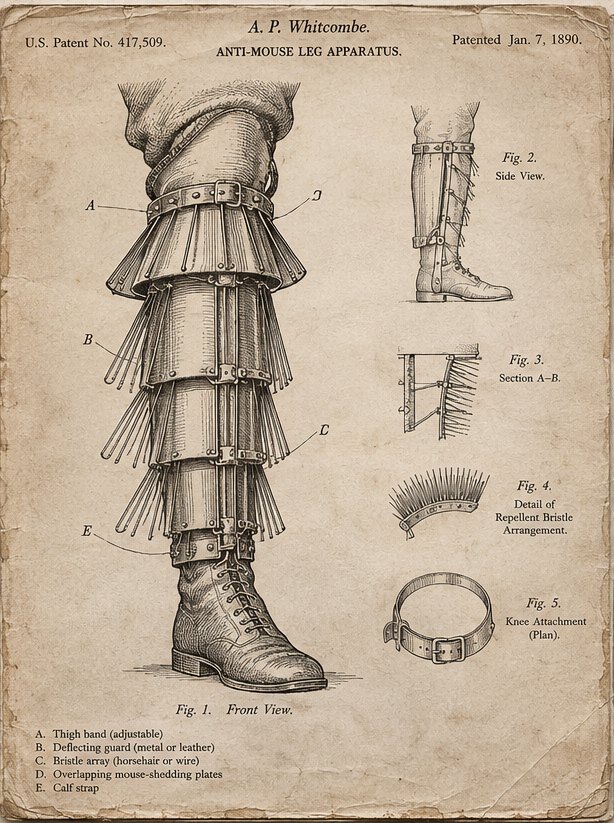
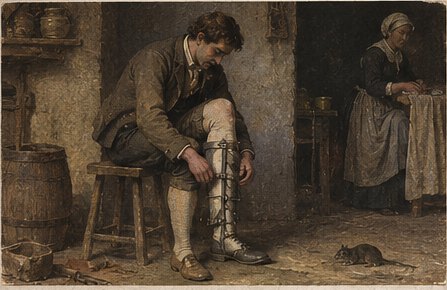
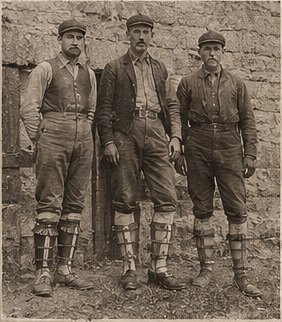
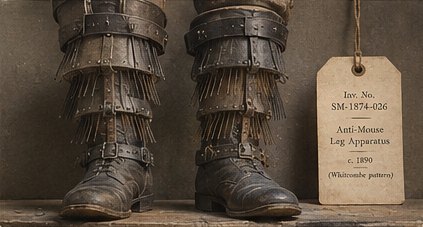
A class of wearable devices devised to prevent mice from climbing a person's legs, particularly in homes, barns, granaries and military quarters where rodent infestations were common, it reached its definitive form in the hands of Alphaeus P. Whitcombe, whose design of tiered, overlapping plates (D) and repellent bristle arrays (C), hung from an adjustable thigh band (A) to a calf strap (E), was patented first in Britain and, thirty-five years later, in the United States.
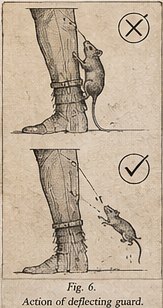
The principle is that of roof tiles. A mouse may climb the lowest plate, but its edge overhangs the next, and the bristles beneath each edge deny the mouse a grip. It is shed, in Whitcombe's word, back to the floor, unharmed and, he hoped, discouraged. Field trials of 1908 found it effective against mice and, unexpectedly, against beetles, earwigs and the attentions of small dogs.
The InventorAlphaeus P. Whitcombe
Alphaeus Peregrine Whitcombe was born in 1831 at Swaffham, Norfolk, the son of a corn factor, and grew up among granaries. He was ascended, by his own count, eleven times before his fifteenth birthday. At twenty-four he wrote to the Royal Agricultural Society proposing the device that would occupy him for the rest of his working life, received a courteous acknowledgement, and secured a British patent the same year at a cost of nearly all he had.
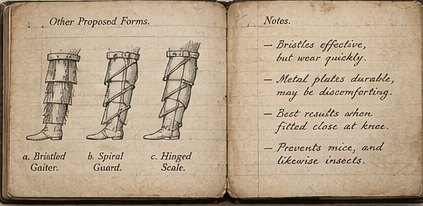
The apparatus did not sell. Farm labourers found it heavy; their employers found it expensive; and a farmer's wife in King's Lynn reported that it “rattled like a knight in armour.” In 1867 Whitcombe emigrated to Springfield, Massachusetts, where he found work as a pattern-maker at the Armory and continued to refine the design at night, replacing iron plates with thin leather and finally with japanned tin.
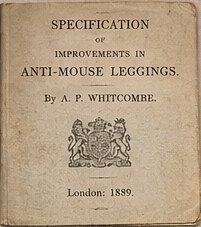
His Specification of Improvements in Anti-Mouse Leggings was printed in London in 1889, and the United States patent followed in January 1890. He was by then a corresponding member of the newly founded P.P.A.M.R.U.L., whose first President described him as “the most patient man in two hemispheres.” He died in Springfield in 1909, having lived to see his apparatus adopted by three granaries, a regiment of Massachusetts militia, and the Society's own Field Committee.

Primary DocumentsThirty-five years of correspondence
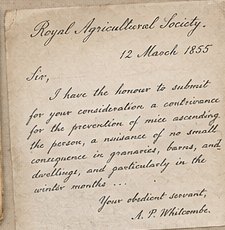
Royal Agricultural Society.
12 March 1855
Sir,
I have the honour to submit for your consideration a contrivance for the prevention of mice ascending the person, a nuisance of no small consequence in granaries, barns, and dwellings, and particularly in the winter months …
Your obedient servant,
A. P. Whitcombe.
Sir, I am desired by the Council to acknowledge the receipt of your letter of the 12th inst., and to inform you that it has been laid upon the table. I am, Sir, your obedient servant, H. M. Pardoe, Secretary.
PatentsBritain, 1855; the United States, 1890
APPLICATION FOR LETTERS PATENT.
To the Commissioner of Patents:
I, ALPHEUS P. WHITCOMBE, of Springfield, Mass., do hereby apply for a patent for a new and useful Anti-Mouse Leg Apparatus, of which the following is a specification.
My invention relates to that class of wearable guards whereby the leg of the wearer is rendered impassable to mice; and it consists of a series of overlapping plates (D), each having upon its lower edge an array of bristles (C) set at a downward angle, the whole being suspended from an adjustable thigh band (A) and secured by a calf strap (E), substantially as hereinafter described.
What I claim as my invention, and desire to secure by Letters Patent, is —
- In an anti-mouse leg apparatus, the combination of a thigh band, a series of overlapping plates depending therefrom, and a calf strap, the lower edge of each plate overhanging the plate below.
- The combination, with the plates of claim 1, of an array of bristles set beneath the overhanging edge of each, whereby a mouse ascending is deprived of purchase and returned to the floor.
- A deflecting guard (B) at the level of the knee, of metal or leather, substantially as and for the purpose set forth.
Jan. 7, 1890
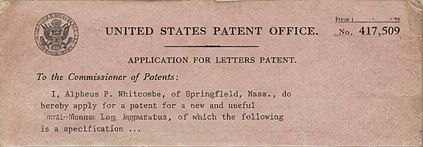
On the British patent. G.B. Patent 12,764 of 1855 was granted under the Patent Law Amendment Act of 1852 and lapsed in 1858 when Whitcombe could not pay the stamp duty of £50 due in its third year. The 1889 Specification was printed to support a renewed British application, which was refused on the ground that the invention had already been published, by Whitcombe, in 1855.
Images & IllustrationsPlates
Related InventionsSee also
Position of the Society
“That this Society recognises in Mr. Whitcombe's Apparatus the most perfect expression yet achieved of the principle that the Leg should be an inhospitable route for the Mouse, and recommends it to all members who can bear the weight.”
Resolution of the Annual Meeting, Bath, 1890. Recommended until 1922, when it was superseded by the elastic cuff.
BibliographySources
- Whitcombe, A. P. (1889). Specification of Improvements in Anti-Mouse Leggings. London: Eyre and Spottiswoode.
- U.S. Patent No. 417,509. A. P. Whitcombe, Anti-Mouse Leg Apparatus. Patented 7 January 1890.
- P.P.A.M.R.U.L. Field Committee (1908). Field Reports, vol. 8: “Trials of the Whitcombe Pattern at Three Granaries.”
- Ashby-Lark, W. (1987). Five Centuries of Ingenuity. Bath: P.P.A.M.R.U.L., pp. 69–98.
- Haverford, M. (1999). The Inhospitable Leg: Passive Deterrence from the Tile to the Cuff. Springfield: Connecticut Valley Historical Press.