
OverviewThe circuit and the mouse
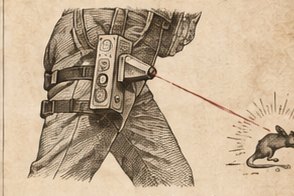
The E.R.E.S. was the first anti-mouse device to know that a mouse was there. Every earlier invention either warned all comers, as the Squeaky-Slapper did, or waited to be touched, as the Mouse-Puncher did. Dr. Abernathy's system sensed, decided, and only then acted.
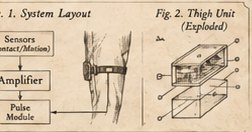
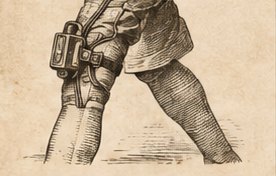
It consists of a thigh unit in a moulded Bakelite case, containing two dry-cell batteries, a vacuum-tube amplifier (replaced in the 1956 model by transistors) and a pulse module; a sensor band of fine copper mesh worn below the knee; and a pair of insulated emission terminals at the ankle. Motion within four inches of the sensor band is amplified and compared against a reference “mouse profile” of weight and gait; if it matches, the pulse module delivers a single brief current across the terminals, sufficient, in the specification's careful words, “to cause the rodent to reconsider its course without lasting injury to either party.”
The name was the inventor's. The Abernathy company's Sales Department proposed Leg-Gard, Mouse-Away and The Gentleman's Friend, and was overruled. Dr. Abernathy held that a device should say what it did. The Archive notes that it did not, strictly, eradicate anything, and that this was the point.
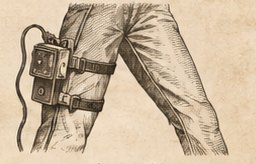
The InventorDr. Lorraine K. Abernathy

Lorraine Kittredge Abernathy took a doctorate in electrical engineering at the Ohio State University in 1939, one of the first women to do so, and spent the war at Wright Field designing proximity circuits for purposes the Archive has not been able to establish. She returned to civilian life in 1946 with a set of ideas about sensing small moving objects, and found that nobody in Dayton wanted to pay for them.
The incident from which the E.R.E.S. descends took place in the pantry of her mother's house on Salem Avenue in November 1948, and is described in her memoir only as “the business with the flour bin.” She filed her patent application sixteen months later.
The Abernathy Electro-Domestic Company manufactured the E.R.E.S. from 1953 to 1961 and sold some eleven thousand units, chiefly in the Midwest and chiefly to women, who were the intended market and whom the advertising addressed with unusual directness. Dr. Abernathy was elected an Honorary Fellow of the P.P.A.M.R.U.L. in 1956, the first American so honoured, and travelled to Bath to receive it. She is said to have worn the device throughout the dinner.
Primary DocumentsMemoranda, a test report, a letter
INTER-OFFICE MEMORANDUM
TO: R. J. Kovach, Sales
FROM: L. K. Abernathy
DATE: June 9, 1952
RE: Product name
Dick —
Thank you for the list. I have read it carefully. “The Gentleman's Friend” is out, since most of our customers will not be gentlemen. “Mouse-Away” sounds like a spray. “Leg-Gard” is misspelled.
It is an electronic system. It acts against rodents. It is meant to make them leave. I accept that it does not eradicate them in the sense your department fears the public will take, but I would rather the name overstate the device's resolve than understate it. The mouse will not read the box.
E.R.E.S. it is.
L.K.A.
File copyFILE E-4471 · SUBJECT: Wearable Rodent Deterrent, Model E-1 (“E.R.E.S.”) · DATE: March 22, 1954
| Test | Result |
|---|---|
| Dielectric withstand, 1,000 V, 1 min. | Passed |
| Case temperature, 8 hr continuous wear | Passed (31 °C) |
| Pulse energy at terminals | Within specification |
| Discrimination, live Mus musculus (2) | 2 of 2 discouraged |
| Discrimination, laboratory cat (1) | 1 of 1 discouraged |
| Discrimination, technician's trouser cuff, wind 12 mph | 1 of 1 discouraged |
CONCLUSION: The device performs as described against mice. Its discrimination of mice from other small moving objects is imperfect. Recommend the manufacturer reconsider the gain setting, and that the technician be issued trouser clips.
Dear Dr. Abernathy,
I have worn your E.R.E.S. every day for a year and I have not had a mouse on me once, and before that I had them twice a week, so I want to say thank you. My husband says to tell you that he does not care for it, because the dog will not sit by my chair anymore, and neither will he.
I would like to buy a second for my mother, who lives on a farm. Please send the Barn kind.
Gratefully yours,
Dolores Fenwick
Muncie, Indiana
PatentU.S. Patent No. 2,714,992
UNITED STATES PATENT OFFICE
2,714,992
WEARABLE ELECTRONIC RODENT DETERRENT SYSTEM
Lorraine K. Abernathy, Dayton, Ohio
Application March 3, 1950, Serial No. 147,330
Patented Aug. 2, 1955 · 6 Claims (Cl. 43—98)
This invention relates to devices worn upon the person for the deterrence of rodents, and more particularly to an electronic system which detects the approach of a rodent to the leg of the wearer and responds thereto with an electrical stimulus of brief duration, sufficient to cause the rodent to reconsider its course without lasting injury to either party.
It is an object of this invention to provide a deterrent which acts only upon a rodent, and not upon other objects in the vicinity of the wearer.*
I claim:
- A wearable rodent deterrent comprising a sensor band adapted to encircle the leg below the knee, an amplifier responsive to motion within a predetermined distance of said band, discriminator means for comparing said motion with a reference corresponding to the gait of a rodent, and a pulse module actuated by said discriminator means.
- The deterrent of claim 1, wherein said pulse module delivers a single current pulse of limited energy across a pair of insulated terminals disposed at the ankle.
- The deterrent of claim 1, further comprising a portable source of electrical energy contained with said amplifier and said pulse module in a housing adapted to be strapped to the thigh.
2,714,992
* See Doc. 2.
Images & IllustrationsPlates


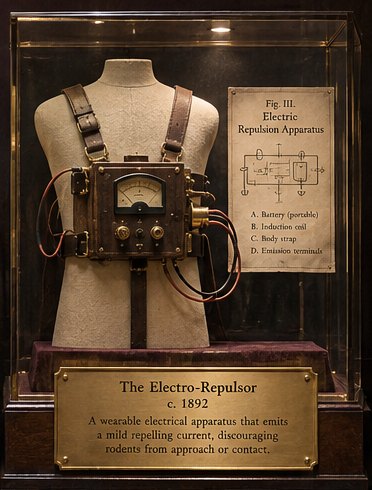
Related InventionsSee also
Position of the Society
“The Society welcomes Dr. Abernathy's System as the first device to distinguish the mouse from the world, and looks forward to the day when it distinguishes it from the cat.”
Citation accompanying Dr. Abernathy's Honorary Fellowship, Bath, 1956.
BibliographySources
- U.S. Patent No. 2,714,992. L. K. Abernathy, Wearable Electronic Rodent Deterrent System. Patented 2 August 1955.
- Abernathy, L. K. (1979). The Business with the Flour Bin: A Memoir. Dayton: Landfall Press.
- Midwest Electrical Appliance Laboratories (1954). Report E-4471. Chicago.
- Ashby-Lark, W. (1987). Five Centuries of Ingenuity. Bath: P.P.A.M.R.U.L., pp. 141–170.
- Nakamura, J. (2008). “Discrimination Problems: Sensing, Gender and the Domestic Deterrent, 1950–1961.” Journal of the P.P.A.M.R.U.L. 121: 33–58.