
OverviewThe beam
The Lazer-Thigh is the most recent principal device in the Archive and the only one still in production, after a fashion. It joins the sensing of the E.R.E.S. to the one deterrent the earlier inventors could not command: light, aimed.
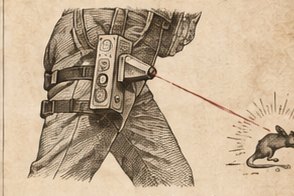
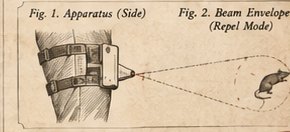
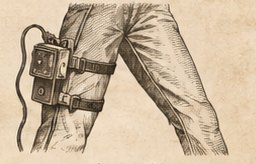
A thigh-mounted unit the size of a paperback book contains an infrared motion array, a microprocessor, and a five-milliwatt helium-neon laser on a two-axis gimbal. The array watches the boot and lower leg for “ascending motion consistent with a rodent profile.” When it finds one, the gimbal traverses and the laser paints a bright red spot on the ground directly in front of the mouse, then draws it away from the wearer in a slow arc. The mouse, the patent explains, “perceives an obstacle, or an opportunity, and in either case departs.”
The beam envelope offers three modes, selected by a rotary switch: Repel, Divert, and a third, marked on early units Eliminate, which was disabled at the factory on every unit shipped, on the advice of counsel and the insistence of the Society. Its presence on the switch has never been satisfactorily explained. The manufacturer's position is that it was “aspirational.”
The InventorDale R. Marchetti
Dale Marchetti grew up on an orchard in the Santa Clara Valley before it was called anything else, studied physics at San José State, and spent the 1970s aligning optical benches for a succession of Sunnyvale firms whose names changed faster than their products. He was, by his own description, “a laser guy who had a mouse problem,” the mouse in question having lived for three years in the walls of his garage workshop and twice ascended him while he was holding a live tube.
His first prototype, built in 1985, was mounted on a belt and aimed by hand. The second added the motion array from a surplus burglar alarm. The third, worn to a Homebrew-era swap meet in 1986, attracted the attention of a retired Lockheed engineer who became his business partner, and of a cat, which became the subject of his first Technical Service Bulletin.
Thighline Defense Systems, Inc. sold the Lazer-Thigh from 1988 until 1996, when the company was dissolved, and Marchetti has since supported the remaining units himself, from the same garage, at no charge. He was elected an Honorary Fellow of the P.P.A.M.R.U.L. in 1990. He has declined to wear the Fellowship's ribbon on the grounds that it interferes with the motion array.

Primary DocumentsManual, release, bulletin, census
LAZER-THIGH™ Model LT-2 · Owner's Manual
Section 4. Selecting a Beam Mode
REPEL. The beam is projected directly ahead of the ascending rodent. Recommended for indoor use.
DIVERT. The beam is projected ahead of the rodent and drawn away from the wearer in an arc of up to 6 feet, leading the rodent elsewhere. Recommended for barns, garages and open-plan living.
ELIMINATE. This position is not functional on your unit. Do not attempt to make it functional. Thighline Defense Systems accepts no responsibility for units on which this position has been made functional.
© 1988 Thighline Defense Systems, Inc., Sunnyvale, California. Pat. Pend.
FOR IMMEDIATE RELEASE
Contact: Thighline Defense Systems, Inc., Sunnyvale, Calif.
THIGHLINE ANNOUNCES LAZER-THIGH™, FIRST LASER DEFENSE FOR THE LEG
SUNNYVALE, Calif., April 4, 1988 — Thighline Defense Systems today introduced the Lazer-Thigh™, a wearable personal laser system that protects the human leg from ascending rodents with “the precision of the space age and the restraint of a good neighbor,” said inventor Dale R. Marchetti.
“For five hundred years, people have tried to stop mice with noise, springs, fire and electricity,” Marchetti said. “We just show them the door. It happens to be a red dot.”
The Lazer-Thigh™ will be available through select hardware and home-improvement dealers at a suggested retail price of $349.95. Batteries not included.
###
Subject: Units in households with cats
Applies to: LT-1, LT-2 (all serial numbers)
Date: November 14, 1989
Owners have reported that in DIVERT mode the beam attracts the attention of household cats, which pursue it. This is expected behavior of the cat and not a malfunction of the unit.
Owners have further reported that the cat, in pursuing the beam, frequently arrives at the wearer's leg, which it then attempts to climb. The motion array does not classify a cat as a rodent and will not respond. Thighline Defense Systems regrets that it has no remedy for this condition at present.
Recommended action: Use REPEL mode in households with cats.
| Device | Lazer-Thigh™, Model LT-2 |
|---|---|
| Serial No. | LT2-01188 |
| Year acquired | 1989 |
| Worn | Daily (garage, workshop, cellar) |
| Mode customarily selected | Divert |
| Ascents prevented, est. | “Hundreds” |
| Ascents not prevented | 2 (both cats) |
| Serviced by | Mr. Marchetti, by post |
| Remarks | Still the best thing I own. Battery door held on with tape. |
PatentU.S. Patent No. 4,857,321
United States Patent [19][11] Patent Number: 4,857,321
Marchetti[45] Date of Patent: Aug. 15, 1989
[54] WEARABLE OPTICAL RODENT DETERRENT
[76] Inventor: Dale R. Marchetti, Sunnyvale, Calif.
[21] Appl. No.: 002,917
[22] Filed: Jan. 12, 1987
[57] ABSTRACT
A wearable device for deterring the ascent of rodents upon the leg of a wearer comprises a housing adapted to be secured to the thigh, a motion-sensing array directed toward the lower leg, a processor for classifying detected motion as rodent or non-rodent, and a low-power laser mounted upon a two-axis gimbal. Upon classification of an ascending rodent, the gimbal directs the beam to a point on the floor ahead of the rodent and may thereafter traverse the beam along a path leading away from the wearer, whereby the rodent is repelled or diverted. A selector permits the wearer to choose among a plurality of beam envelopes, at least one of which shall be inoperative.
11 Claims, 4 Drawing Sheets
In continuinguse
Images & IllustrationsPlates


Related InventionsSee also


Position of the Society
“The Society commends the Lazer-Thigh to members, in Repel or Divert mode only. It notes with satisfaction that the device returns the art, after five centuries and by way of fire, to the principle of Hieronymus Clapp: that the mouse should be persuaded to go elsewhere.”
Resolution of the Annual Meeting, Bath, 1990.
BibliographySources
- U.S. Patent No. 4,857,321. D. R. Marchetti, Wearable Optical Rodent Deterrent. Patented 15 August 1989.
- Thighline Defense Systems (1988). Lazer-Thigh™ Model LT-2 Owner's Manual, 2nd ed. Sunnyvale.
- Thighline Defense Systems (1988–1996). Technical Service Bulletins TSB-88-01 to TSB-95-11.
- P.P.A.M.R.U.L. (2019). Census of Apparatus in Service. Bath: the Society.
- Ashby-Lark, W. (1989). Five Centuries of Ingenuity, 2nd ed., with a supplement on the Lazer-Thigh. Bath: P.P.A.M.R.U.L., pp. 171–188.