
OverviewThe first wearable defence
The Squeaky-Slapper is the oldest wearable anti-mouse device of which a physical specimen survives, and the first to proceed from the principle on which much of the later literature depends: that a mouse which can be made to reconsider will generally do so.
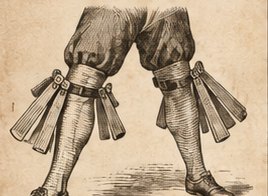
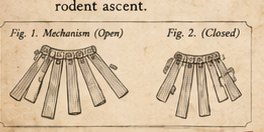
It consists of a pair of leather garters, each hung with six to nine hinged slats of seasoned ash. Worn below the knee, over the hose, the slats strike one another with every step, producing what a contemporary called “a clatter as of a cart of empty barrels let down a stair.” A mouse approaching the foot of a wearer in motion is confronted with a noise many times its own size, and departs.
The device's weakness, recognised at once, is that it protects only a wearer who is walking. A wearer at rest, at table or in prayer, is silent and therefore undefended. Clapp's answer, recorded in the Council minutes of 1538, was that the wearer should not be at rest. The Council's answer is also recorded.
The InventorHieronymus Clapp of Nuremberg

Hieronymus Clapp was born in or near Fürth around 1497 and is recorded in Nuremberg from 1521 as a maker of wooden rattles, clappers and the Ratschen sounded in place of church bells during the last days of Holy Week. It was a seasonal trade. For fifty weeks of the year, a man who made noise for a living had very little to make noise about.
The idea of the Squeaky-Slapper came, by his own account, in the winter of 1537, in the cellar of his workshop on the Zistelgasse, where he kept his ash staves to season and where the mice kept themselves. “They went up my left leg as though it were the tower of St. Sebald,” he told the Council, “and I am not a tower, and I will not be treated as one.”
He sold, by the evidence of his surviving account leaf, forty-one pairs in the first year, chiefly to millers, cellarers and the wives of bakers. He sold four in the second. He died in 1561, a member in good standing of no guild, and was buried at St. Johannis. The Society laid a wreath there in 1938, on the four-hundredth anniversary of the device, and has done so every twenty-five years since.
Primary DocumentsThe record in their own words
Item. Upon complaint of the churchwardens of St. Lorenz that during the sermon of Sunday Laetare one Hieronymus Clapp, clapper-maker, did walk the length of the nave and back again three times, wearing upon either leg a device of boards that made a great clattering, so that the preacher could not be heard and two infants were woken, the said Clapp being summoned answered that he walked for the protection of his legs against mice, and that a man standing still in a church is as good as a ladder to them.
It is resolved: that the said Clapp may wear his boards in his own house, in his cellar, in the street and in the market, but not in any church, nor in the council chamber, nor at any wedding, nor in the presence of the Imperial envoy; and that if he must walk in church he shall first take them off.
It is further resolved, upon the motion of Herr Löffelholz, that the Council does not doubt the mice.
Master Clapp,
I write to say that the boards are come and that I have worn them these nine days. My husband says that he can hear me in the counting-house, which is in the next street, and that the dogs will not sleep. But I have not had a mouse upon me since Candlemas, and I will thank you to make a second pair for my sister, who is a widow and lives alone, and has nobody to hear her.
Your friend in this matter,
Ursula Kesselbrandt
A True Description of the New Mouse-Clapper, with which a Person may Go Abroad without Fear of the Ascending Mouse, now Made and Sold by Master Hieronymus Clapp at the Sign of the Rattle.
Whosoever hath been troubled in cellar, mill or larder by the Mouse that climbeth up the hose and into the breeches, to the great affright of the Person and the shame of the Household, let him buy these Boards, which being bound below the knee do clap at every step, and the Mouse hearing them doth run away, as the Philistine before the trumpet. Proven in Nuremberg upon many legs. Not to be worn in church.
⁂
Catalogue & InventoryNo patents; one halberd
No system of patents existed in sixteenth-century Nuremberg, and Clapp sought no privilege from the Emperor. The device's claim to priority rests instead on two entries: the city armoury's inventory of 1547, in which a pair is listed among the ordnance, and the Society's own catalogue card, prepared when the specimen entered the Archive in 1891.
Item, 212 halberds, of which 9 wanting heads.
Item, one pair of boards for the legs, against mice, made by Clapp, of ash, with garters. Confiscated from the said Clapp at the Christmas Mass.
Item, one leather bucket.
OBJECT: Garters, pair, w/ hinged clappers (7 + 8)
MAKER: H. Clapp, Nuremberg
DATE: c. 1538 (by inventory 1547)
MATERIAL: ash; calf leather; iron pins
CONDITION: 2 slats replaced 1891. Audible.
ACQ.: Purchased, Nuremberg dealer, 1891
NOTE: Do not demonstrate in Reading Room.
Images & IllustrationsPlates



Related InventionsSee also
Position of the Society
“The Society regards the Squeaky-Slapper as the foundation of the art, and its maker as the first of our number, though he died three centuries before we were convened. Its principle, that a mouse may be dissuaded rather than defeated, is the one this Society holds dearest.”
Resolution of the Annual Meeting, Bath, 1888.
BibliographySources
- Dunstable, A. (1911). The Nuremberg Mouse-Clapper: Documents Translated, with a Note on the Ratschen. Bath: P.P.A.M.R.U.L. Occasional Papers, no. 4.
- Hörnlein, K. (1926). “Hieronymus Clapp und die Klapper.” Mitteilungen des Vereins für Geschichte der Stadt Nürnberg 29: 211–214.
- Thorncastle, E. (1889). Address to the Second Annual Meeting, upon the Antiquity of Our Cause. Bath: privately printed.
- Ashby-Lark, W. (1987). Five Centuries of Ingenuity: The Centenary Catalogue of the Simulacra Archive. Bath: P.P.A.M.R.U.L., pp. 3–19.
- Pemberton-Hale, R. (2004). “Silence as Vulnerability: The Stationary Wearer in Early Acoustic Deterrence.” Journal of the P.P.A.M.R.U.L. 117: 44–61.